

Fully automated basic security communism
On the polarisation over material and post-material values

As political horizons continue to narrow, ever-greater numbers of political aspirations get denounced as “luxury beliefs”. Political realism is crucial, but this need not imply we give up the horizon of emancipation. So is it mean and wrong to call ideals that rest on people being better people “luxury beliefs”? No. Maybe these demands or ideals really are superfluous, flighty.
This understanding need not be conservative, in the sense of limiting oneself to what has already existed in the past, or of defending coercive institutions and practices, or of dismissing popular aspirations for the good life. In fact, when we think about “luxury beliefs” and their opponents, we shouldn’t see the face-off as being between radicals (abolish the police, no borders) and conservatives (punitivism, xenophobia). Instead it is a division between those holding post-material and material values. Materialist values can concern things like social order, economic growth, wages, poverty, war; post-material values often focus on environmental protection, sexual autonomy, political participation, meaningful jobs.
Each of these poles has its radical and conservative interpretations. We can imagine it as a four-square grid.
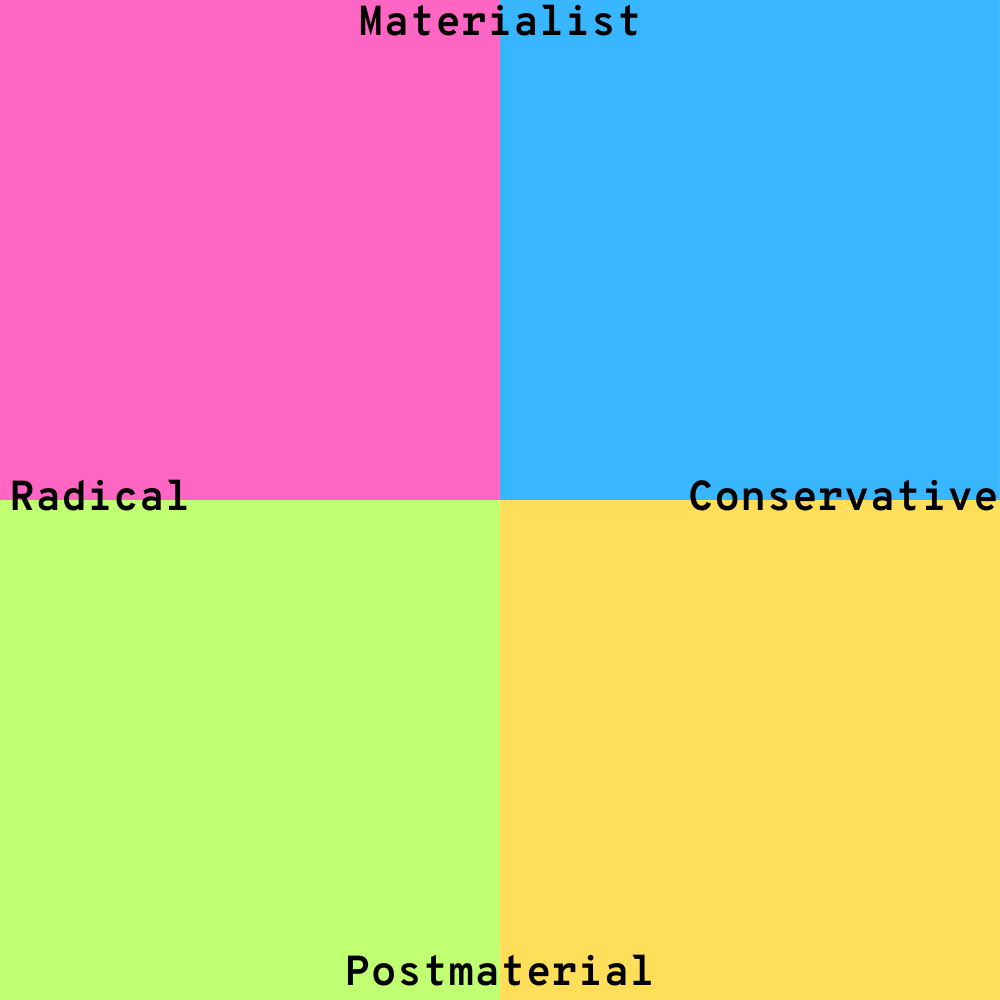
The past decade has seen a face-off between post-material ‘radicals’, and their materialist conservative critics. Lately, the latter have found it rather easy to counterpoise the serious stuff of physical security against outré, unpopular demands that often presume a much more genteel world than the one most people live in.
Politics in a lot of places has recently looked like this.
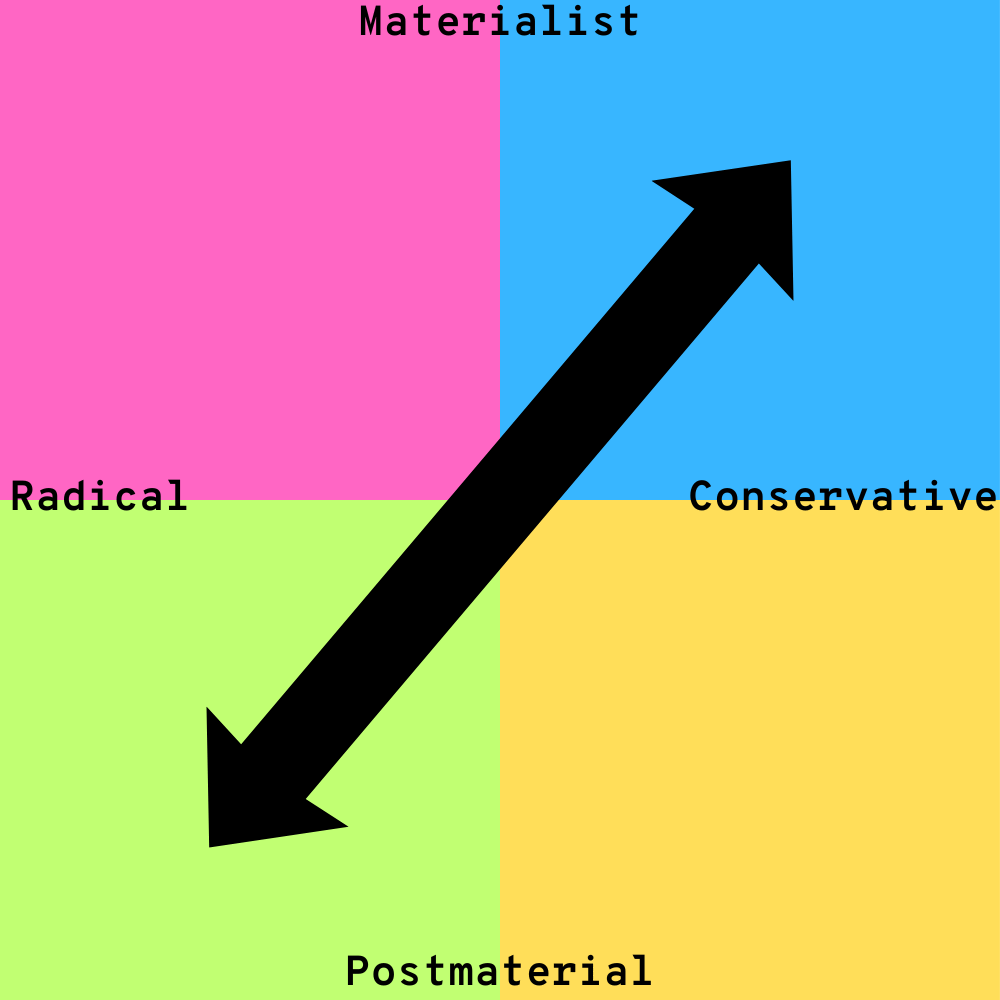
Take issues like crime, migration, the environment. You have progressives saying that we need to change things, that we can have a world with fewer prisons or prisoners, with more open borders, and with care for the planet, and you have conservatives saying, “we don’t have time/money for that shit”.
That the latter are winning is testament to the closure of a big historical arc that began in the 1960s. The return of identity politics to the right, and the radical right’s growing power, influence and electoral success, suggest that the progressivism which installed itself as culturally hegemonic over the past decades is under serious challenge.
But Inglehart’s post-materialism doesn’t just embrace hippyish tree-hugging, just as the understanding of material values can’t be reduced to the defensive stance of the law-and-order authoritarian. Material values include economic security – e.g. good jobs, welfare, public services – and post-material values can concern the post-bourgeois entrepreneur’s drive for self-realisation in the market.
The fact that “left vs right” has come to be understood as post-material radicalism versus material conservatism is testament to the severe limitations of understanding politics that way today.
It is true that left vs right politics may once have looked something like this (below), with the radical camp regrouping concerns such as economic security, democracy, and free speech and the right concerning itself with order and tradition, but those days are long gone.
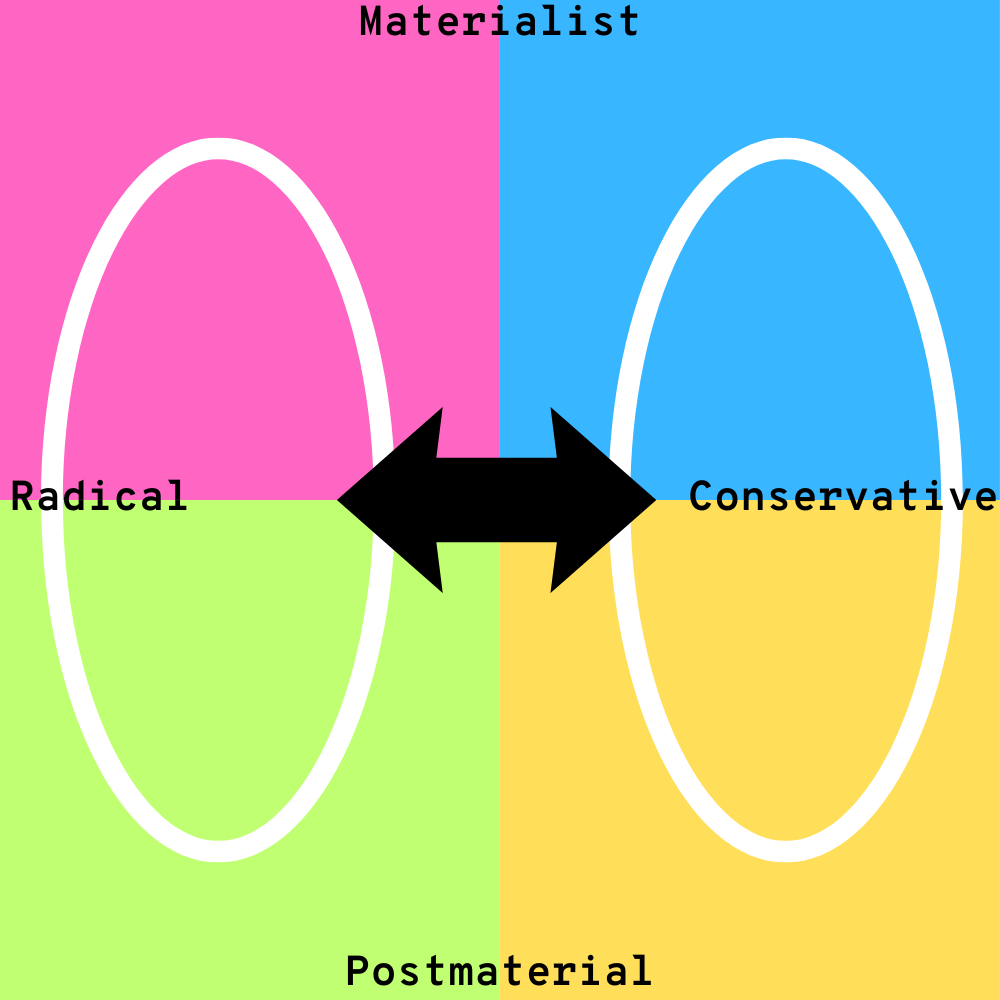
Moreover, the drive for recognition and self-expression is now generalised across the political spectrum, whether framed as explicit demands or not. Everyone is an identitarian, everyone wants attention on the internet, etc etc. Moreover, both liberal progressivism and varieties of conservatism have a tendency to take up post-material framings as a way of shutting down material demands.
That would seem to vindicate Inglehart’s “silent revolution” hypothesis, according to which the waning of scarcity would lead to the greater prevalence of post-material values. On the other hand, an increasingly chaotic, decadent, post-growth and oligarchic capitalism makes concerns about economic and physical security increasingly present, and recentres the need for modernisation.
But rather than conclude by deciding whether the post-material hypothesis is right or wrong, whether post-material values have won over or not, we should think through the process of transformation historically. Part of the strangeness of our time is a reflection of the way this wave of post-material values, or more broadly post-modernity, washed over Western societies over the past half-century and has now receded, but transformed these same societies in its wake.
It’s why material concerns that could be associated with both right and left (crime or public services; migration or democratic power) get tangled up with debates about meaning, with questions about who we are; why descriptive and symbolic representation so often stands in for substantive representation. It’s why, ultimately, politics often looks like this…
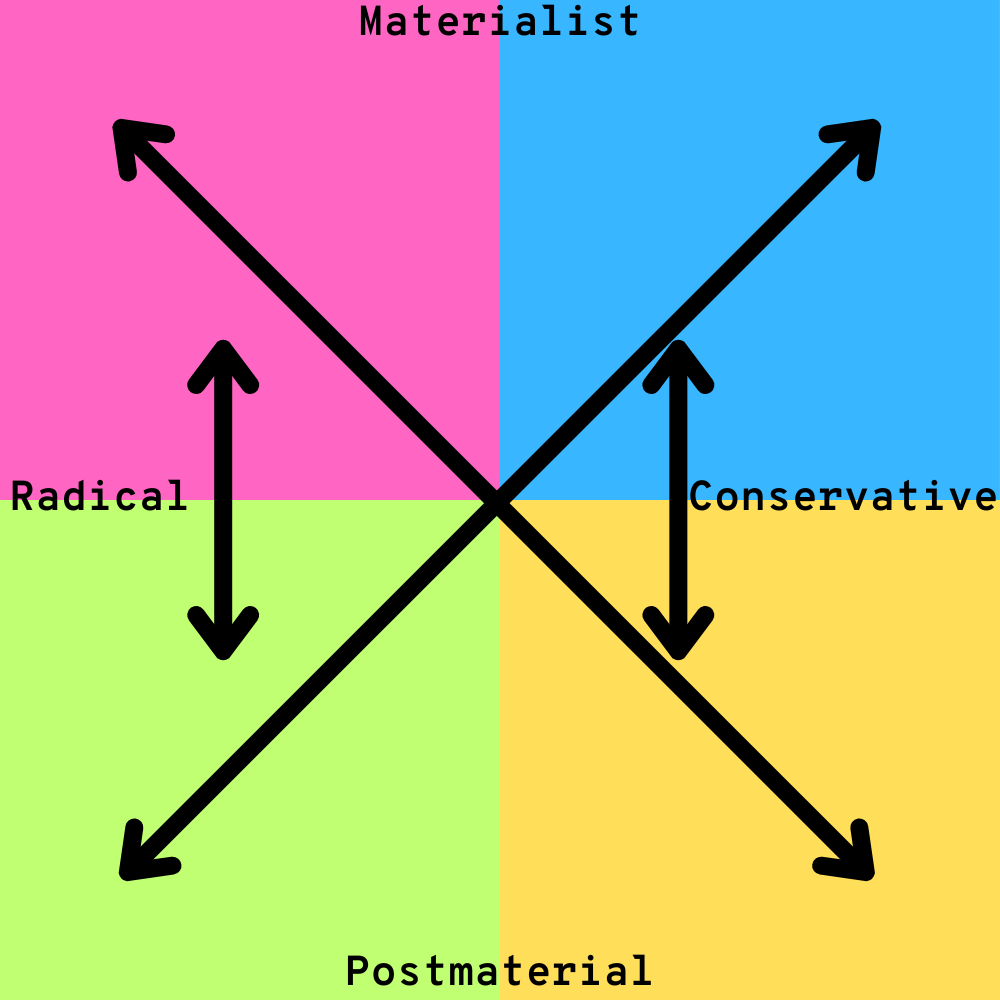
…and why our current hyperpolitics can’t even be satisfyingly resumed in a 2x2 chart.
Ultimately, realism demands understanding where we are in history, knowing what time it is, and thus recognising that demands for security – not just economic but physical and existential – need to be addressed and not taken for granted, much less minimised or dismissed. It’s not a place we thought we’d find ourselves in, from the perspective of the later 20th century, but here we are.
I find Ben Studebaker's term "middle capitalism" a helpful way to think about the class basis for this transformation. The classical, materialist working class was defeated and partially replaced (with the precariat below and professional salariat above), but never fully eliminated. The "new" class strata have come to occupy a large demographic portion of society and an outsized political voice, but they can never constitute a social majority. Capitalist politics proves incapable or unwilling to universalize the material security that could raise everyone into the postmaterialist political sphere but nonetheless dominates the materialist political forces from below.